This is our first post/analysis in English. Why?
For the second time in a few weeks, a likely Russian decoy drone “Gerbera” breached Lithuanian and NATO airspace. Previously, the long-range strike drone Geran-2 breached the Latvian border.
So, Houston, we have a problem. We hope that our contribution to situational awareness regarding regional military security might be useful not only for our Lithuanian readers but also for the international community.
Here you will find an analysis of Russian long-range strike drones (LRSD): their purpose of use, production dynamics, operations, and countermeasures. We will conclude this with suggestions to NATO member states, especially around the Baltic Sea region.
Purpose of use
The starting point is summer/autumn 2023, when Russia began using Iranian Shahed-type LRSD (now called Geran-2).
Compared to cruise/ballistic missiles, LRSDs have lower speed (200 km/h vs. 600–800 km/h), weaker warheads (50–90 kg vs. 400 kg of explosives), lower cost ($200K vs. $1–10 million), not radically different operational range (up to 2000 km vs. 3500 km), and insufficient resistance against EW. This is (and still is) the reason they are mainly used against targets less protected by air defence (civilian infrastructure, residential areas), i.e., essentially used as weapons of terror against civilians.
They are also used to overload an opponent’s air defence system. During massive combined attacks (MCA — missiles + drones), the use of air defence missiles and munitions against LRSDs allows faster and more powerful cruise/ballistic missiles to reach targets more easily.
However, from 2024, it has become clear that with technological improvements (EW survivability, navigation, engines, combat power), increased drone production capacity, and testing of swarm operations (a dozen or more drones per target, e.g., a city), LRSDs themselves now offer sufficient deep-strike capability, especially during massive attacks.
This was one reason to develop decoy drones (e.g., the Gerbera), which fulfill the same function as LRSDs do for missiles — to achieve a massive effect. There is also a growing number of other attack drones with various ranges (e.g., Molnia). In addition, to increase lethality and draw the attention of air defence systems, decoy drones are equipped with small warheads (a few kilograms).
Production and logistics
Russia is capable of innovating, manufacturing, and deploying LRSDs without foreign (Iranian, Chinese) support. That support may still be helpful, but it is no longer crucial as it was two years ago.
Based on open-source information, Russia produces about 90–100 Geran-2/Shahed drones per day (~3000 per month), while the production of all types of long-range drones has reached around 5500 per month.
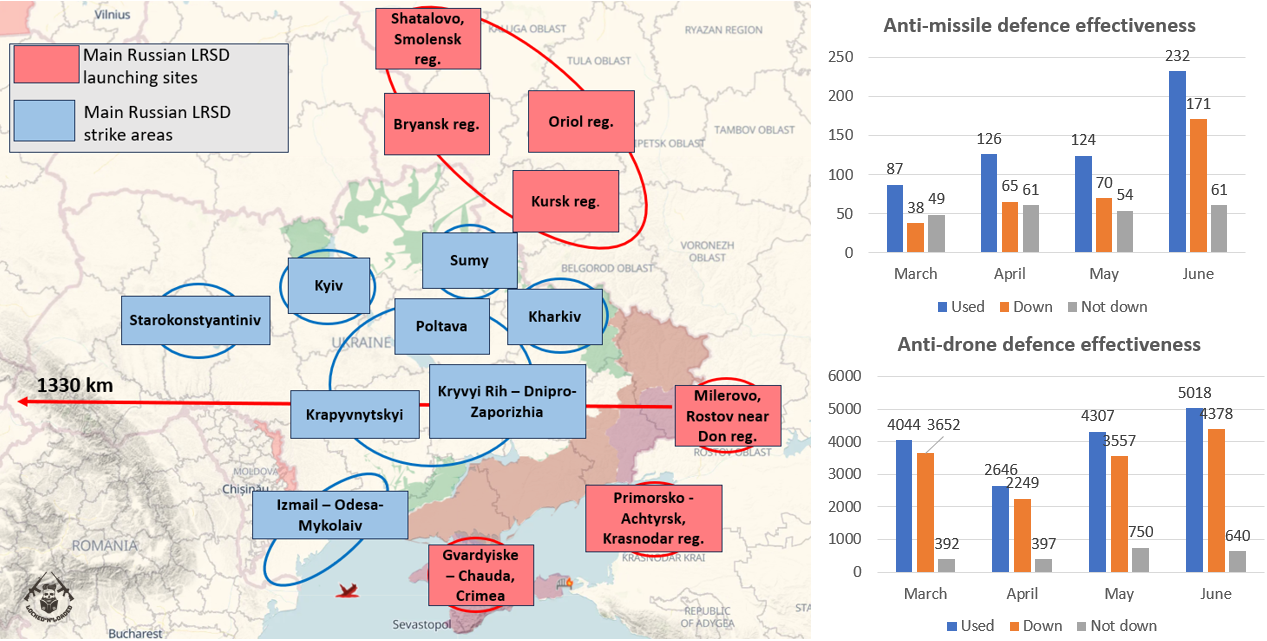
There are two main factories where Shahed/Geran-2 drones are produced: Yelabuga and Izhevsk (1300 km from the contact line). Component production is also being developed — for example, warheads are made in the Moscow district (980 km from the production sites), and “Kometa” antennas (enabling EW resistance) are made in Cheboksary (400 km away). This means supply chains are long and segmented, complicating the delivery of drones to launch sites.
This likely contributes to the decreased intensity of LRSD strikes, which occur in cycles of several months. Russia is likely forced to stockpile long-range drones to organize large-scale strikes.
Ukrainian forces can reach these production sites with their deep-strike capabilities but have not yet produced a game-changing effect — mainly due to a lack of tools (long-range missiles, sufficient long-range drones) rather than due to effective Russian air defences.
Operations
Targeting: The aggressor uses long-range ISR drones to locate HVTs (high-value targets). This intelligence is mainly used for faster and more powerful deep strikes (via cruise and ballistic missiles). However, ISR and other intel sources are also used to assemble a broader operational picture, prioritize targets, and coordinate combined strikes (missiles + LRSDs).
Launch platforms and OPSEC:
Shahed-136/Geran-2 drones have several launch options:
- Stationary ground-based platforms
- Containers mounted on trucks or other mobile platforms (5 drones per container)
- Launch from moving vehicles (e.g., a jeep)
This flexibility enables deception, improved OPSEC, and makes it harder for Ukrainians to identify and strike launch sites.
The aggressor sets up warehouses near launch areas (within ~70 km) for storage, repairs, and mounting. This logistics pattern can help locate launch sites, as it did with Ukraine’s drone strike on a warehouse in Yeisk near the Primosk-Akhtyrsk launch site.
Tactics:
Due to technological improvements and production capacity, LRSDs are increasingly used to strike military targets (e.g., Kropyvnytskyi airfield, logistics hubs).
Missiles are increasingly being replaced by LRSDs. In November 2024, the missile-to-LRSD ratio was 1:9; by June 2025, it was 1:21. Russia is using more missiles overall, but LRSD use is growing much faster. In June, over 5000 strikes occurred, with projections of more than 700 drones per single strike. The New York Times estimated that by autumn, Russia could deploy 1000 drones in one strike.
MCA (at least 10 cruise/ballistic missiles + 300 LRSDs) recur after 4–7 days of lower-intensity activity. In May–July 2025, Russia began repeating MCAs on consecutive days.
Most drone launches occur from 300–400 km behind the front line, with most targets also located 300–400 km inside Ukraine. Western Ukraine is still targeted (e.g., Starokostiantyniv, Vinnytsia, Lviv), but the trend suggests an average operational range of 700–800 km.
Shahed/Geran-2 drones have a maximum range of 1500–2000 km, but they follow complex pre-programmed flight paths (maneuvering, circling), so their effective strike radius is much shorter.
Countermeasures
Electronic warfare (jamming) is one of the most effective tools — 30–50% of LRSD losses are caused by Ukrainian EW systems. Drones are diverted from their targets by disrupting their navigation.
Other tools include helicopters, light subsonic combat-training aircraft, mobile teams with heavy machine guns, MANPADS, anti-aircraft artillery, etc. Ukraine is also developing its own drone-based air defence, which is effective against Russian ISR drones and increasingly used against LRSDs.
Modern systems (e.g., NASAMS, Patriot, F-16 air-to-air weapons) are in place, but the cost-effectiveness is questionable. Also, using supersonic jets against slow drones is risky — e.g., during a June 28–29 attack, a likely F-16 downed a drone but was lost due to the explosion and debris proximity.
Recently, LRSDs have flown above 2 km, reducing the effectiveness of mobile machine-gun teams. Still, these teams remain useful at the target area and may include MANPADS and anti-aircraft artillery.
In 2025, Ukraine intercepts about 50–70% of cruise and ballistic missiles monthly (around 60 missiles still hit). Anti-drone defence is more effective — 80–90% of LRSDs are neutralized. However, in a 500–700 drone attack, even 10% (50–70 drones) cause significant damage, especially if concentrated on one location.
Suggestions
The aggressor is not abandoning LRSDs but evolving them. NATO must pursue consistent scientific, technological, and military analysis, and develop both adaptive and revolutionary countermeasures.
In a large-scale conflict, MCA operations will likely target the Baltic region to disrupt allied logistics and military infrastructure. Therefore, NATO and regional states should:
- Distribute responsibilities among military, reserves, home guard, and paramilitary units to protect military assets, critical infrastructure, and civilians. Equip and train them for interoperability.
- Improve early warning systems to detect aerial threats (including ISR and LRSDs) at sufficient distances to act (e.g., shoot down, jam).
- Develop intelligence capabilities (electronic, drone-based, etc.) to identify deep-strike infrastructure at 300+ km and integrate it into targeting processes rapidly.
- Maintain doctrinal fire assets (e.g., HIMARS) and long-range drones with a range of 300+ km. Consider forward-deploying these outside home territory before conflict begins.
- Air defence shouldn’t rely solely on expensive systems. Given the intensity of potential attacks, losses and missile shortages will be hard to replace. Thus:
- Develop EW capabilities to counter air threats
- Integrate older air defence systems, aircraft, helicopters
- Build mobile air defence teams with machine guns, MANPADS, AAA, and mobile EW
- Develop drone-based air defence and training
- Integrate all systems into a unified, flexible framework with high situational awareness
Temos: